Showing posts with label restaurant style. Show all posts

Sunday, February 21, 2016

Low Fat Chilli Paneer : Indo Chinese Recipe


Chilli Paneer. Cubes of paneer coated in spicy indo-Chinese sauce. Indo Chinese is Indian style Chinese food.  This started as a popular street food in India and later on even restaurants started putting it on the menu-such is the taste and popularity of this dish. There are two ways it is made. Dry style, in which paneer chunks are only coated in the sauce.  Other way is with gravy wherein the sauce is kept liquid. Dry chilli paneer is mostly served as snack, starter or appetizer; whereas wet chilli paneer is served as side with fried rice or noodles. 

This is one dish that always pops in my mind when I am in hurry and guests are coming over for lunch or dinner. Because its easy and quick you don’t need much time to prepare it and because it is popular every guest will love it. So, ideal recipe involves frying paneer cubes and then mixing it in the sauce but I don’t like this method as it makes paneer very hard and rubbery. Here is my way to make Low Fat Chilli Paneer.


Ingredients:
225 grams paneer cut in cubes
1 capsicum/bell pepper, cut in cubes
1 onion large, cut in cubes
4-5 cloves of garlic, finely chopped
1 tablespoon ginger, finely chopped
2 green chillies, slitted
Black pepper powder, to taste
Salt, to taste
1 tablespoon soya sauce
½ tablespoon chilli sauce (red/green)
1 tablespoon corn flour
¼ tablespoon lemon juice or vinegar
1 teaspoon sugar
2 tablespoons sesame oil
1-2 tablespoons chopped green onions (green part only)


Method:
Boil 2 cups of water and add paneer cubes in it. This will make paneer soft. Drain water and keep aside.
Mix 4 tablespoons of water in corn flour and keep it aside.
Heat oil in a pan or wok. When oil gets very hot add garlic and ginger. Saute for 30 seconds.
Add slit green chillies and chopped onion. Saute for 10 seconds.
Next throw in chopped capsicum. Sauté for 10 seconds.
Add salt, sugar, black pepper, soya sauce, chilli sauce, lemon juice and corn flour mixture. Cook it for 30 seconds.
Throw in paneer cubes. Mix well so that paneer cubes are coated well with spices and sauce. Keep it covered for 1 minute.
Check salt and heat level. Adjust if needed. Garnish with chopped green onions and serve.

Notes:
Never add too much salt, remember soya sauce and chilli sauce also contains salt.
Make sure that you don’t overcook capsicum and onion. They should be bit crunchy.
Chinese food is cooked on high heat, this gives good smokey flavour. Do not leave it unattended.


Monday, June 29, 2015

Jeera Rice: Basmati Rice With Cumin Seeds: Indian Rice


Some one the other day asked me for the recipe of Jeera Rice and I was so shocked to know that the recipe is not on my blog. I mean you aren’t an Indian food blogger if you don't have jeera rice recipe on your blog. No seriously, I was so ashamed. Jeera Rice is like run in the mill in most of the Indian homes. Anyways, that day itself I made jeera rice clicked the pics and here I am posting it without any further delay.

Jeera as we call in Hindi is cumin seeds and is THE most important ingredient in Indian Punjabi cooking. Personally I cant do without this spice, be it paneer currieskofta curries or homemade spice mix like chaat massala or garam massala. The ancient Ayurveda and age old wisdom of grandmothers insist on having cumin seeds because of its medicinal values.


Common benefits of cumin seeds are:
Improves digestion
Increases concentration
Reduces cholesterol
Weight loss
Relieve stress
Deceases bloating and gas
Detoxifies liver
Reduces menstrual cramps
Increases lactation in new mothers


Coming back to the post, Jeera Rice is basmati rice (chawal) which is flavored with cumin seeds. Cumin seeds are roasted in ghee or butter to release the aroma, later cooked rice is mixed in it. Now here is one modification that take place, some use cooked rice (boiled rice) while some cook the rice with cumin like how you would do for biryani or pulav. No method is right or wrong, you do what you prefer. Things that remains the same is ghee (clarified butter), some cloves (laung), bay leaf (tej patta) and lots of cumin seeds.


Use a good quality long grain basmati rice for best results. You can read a complete post on how to cook rice perfectly for moretips and clear idea. I always cook rice in microwave to save time and then just pour the cumin seeds tempering on the rice, mix and cover it for 1 minute so that flavoures remain intact. This is the Plain Jeera Rice recipe, which is more like day-to day rice; to give it more elegant restaurant feel then you must add cashews and raisins (kaju and kismis).

What to pair with jeera rice? Check these out:

In simple words, jeera rice is a step further both in looks and taste from the regular plain boiled white rice. The little golden coloured cumin seeds mixed with pure white boiled rice gives a uplifting colour combination. 


Author: Shweta Agrawal
Cuisine: Indian: Punjabi: Bangladeshi: Pakistani
Serves:2-3


Ingredients:
1 and 1/2 cups basmati rice
1 teaspoon lemon juice
2 teaspoon cumin/jeera
1 bay leaf/tej patta
2-3 cloves/laung
3 cups water
2 tablespoon butter/ghee
Salt to taste

Method:
Wash basmati rice two three times. Soak the basmati rice in water for 30-40 minutes. Drain the rice and keep aside.
Put rice in microwave safe bowl. Add 3 cups of water, lemon juice and salt. Cook on high power for 12 minutes. Cover the bowl with plate and cook again for 8 minutes.
Heat a pan. Add ghee or butter. Reduce the heat to low.
Add in cloves, bay leaf and cumin seeds. Let cumin seeds turn golden. Heat a pan.
Add cooked rice and stir with softly. Make sure not to apply lot of pressure else rice will become mushy.
Let it sit covered. Fluff the rice and serve jeera rice hot.


Notes:
You can also use cardamom (elyachi) or cinnamon (dal chini) in the recipe. However I don’t like sweet aroma in rice so I avoid it.
You can use vegetable oil or sunflower instead of ghee or butter.
Lemon juice helps to separate the rice grains and gives nice white colour.
Use good quality long grain basmati rice. I recommend Tilda Basmati Rice.

Serving suggestion:
Serve as side with any indian curries.
Serve with lentils and dry curries.
Mix with salad, chutneys and stuff in tacos or burritos.


Thursday, May 7, 2015

Mango Lassi: Aam Ki Lassi: Restaurant Style


Last year UK government put a ban on import of mangoes. Whole summer season passed away and there was no sight of mangoes. Friends and family in India uploaded the pictures on facebook and instagram of/with mangoes-ah I was so jealous. There was a time when I hated mangoes; because the fibre would stick in my teeth and the heat of mangoes would give me horrible pimples on my face. For me mango was confined to readymade Indian drink such as slice or mazza or frooti.

Then I got married to a mango addicted person, someone who can live on mangoes. I gave him all possible reasons-cum-excuses on why I hate mangoes, but he only smiled. One day, he got alphanso mangoes from a very old and famous Mumbai vegetables/fruits market. Quietly he kept the box of mangoes in the fridge. Next morning, he soaked two mangoes in the water for two hours. He came in our room; he had two plates, one knife and 1 fork with him. While was getting grumpy seeing the mango, he just dint react. Very carefully he peeled the mangoes with the knife, and neatly chopped mangoes into small pieces (that was the tidiest mango chopping, I ever saw). He picked one tiny piece with a fork and asked me to smell it. Okay, I said and sniffed. Now eat it, he said. No way, I replied. Just one piece, he forced. I opened my mouth and gulped. And it was summer in my mouth- fresh, pulpy, sweet and juicy mango; yummy I said in excitement. He smiled, gave the plate and fork to me and said, enjoy! And that is how and when I fell in love with alphonso mangoes.


My relation with mangoes has gone stronger after coming to London, I tried many mango recipes. I have prepared classic Indian mango phirnieggless mango mousse with canned mango pulp; I treated my husband with mango mousse cake on his birthday two years back; you can see gujarati keri nu ras (aamras) recipe on my blog too; or check French mango crêpe cake if you like something fancy. Today it is a simple and easy mango drink that is very famous in the UK, called as Mango Lassi.

Also, mangoes are the favorite fruits of my two mothers, maa and mom in law, so I just timed it right for Mother's day :) In case you are still wondering about gift ideas, then see my post on 5last minute budget gift ideas for mothers' day.

Lassi is a Punjabi (north Indian) drink that is relished during summers. I explained in detail about lassi in the post of Strawberry Lassi. There are many ways to make it and no one way is right or wrong. Basically mango pulp and yogurt (dahi) are the two main ingredient, rest all depends on your preference. Ingredients like cream, rose water, milk, ice cubes, sugar, mint leaves, saffron (kesar), cardamom (ilyachi) are the elements that you can add or omit depending on your taste.


The lassi recipe I am sharing today is one that we get in the Indian restaurants here in the UK. Restaurant style mango lassi is sweet and thick, dark yellow in colour, garnished with saffron threads. You can see lots of modifications in the notes below.

Ingredients:
2 ripe mangoes (I used alphanso)
1 cup yogurt (I used full fat)
2 tablespoons sugar
1 teaspoon saffron/kesar
4 ice cubes
2 tablespoons milk

Method:
Peal mangoes and remove all the pulp. Discard the seed.
In the blender, blend yogurt, mango pulp, sugar and ice cubes.
Heat two tablespoons milk. (I used microwave for this). Mix 1/2 teaspoon of saffron in the warm milk.
Put saffron and milk mixture in the blender and blend again.
Serve in glasses. Garnish with remaining saffron threads. Serve chilled.


Notes:
You can use cream for creamy and velvety texture.
For thinner lassi, use 1/2 cup milk and 1/2 cup yogurt.
You can add vanilla essence, cardamom or rose water for flavour. However I feel these ingredients are more powerful and thus the real mango taste subsides.
Mixing saffron in milk gives dark yellow colour to lassi, however this is optional. You can skip saffron for garnishing as well.
Quantity of sugar also depends on mangoes. Adjust the sugar depending on how sweet the mangoes are.
Saffron is available in any Indian grocery store. I used Mehr Red Saffron.


Serving suggestions:
For a party, serve in fancy wine glasses. Garnish with rose petals, saffron threads, chopped nuts.
It is filling too, you can give it your kids as an evening snack, or have it as post-workout or gym snack.

Monday, May 4, 2015

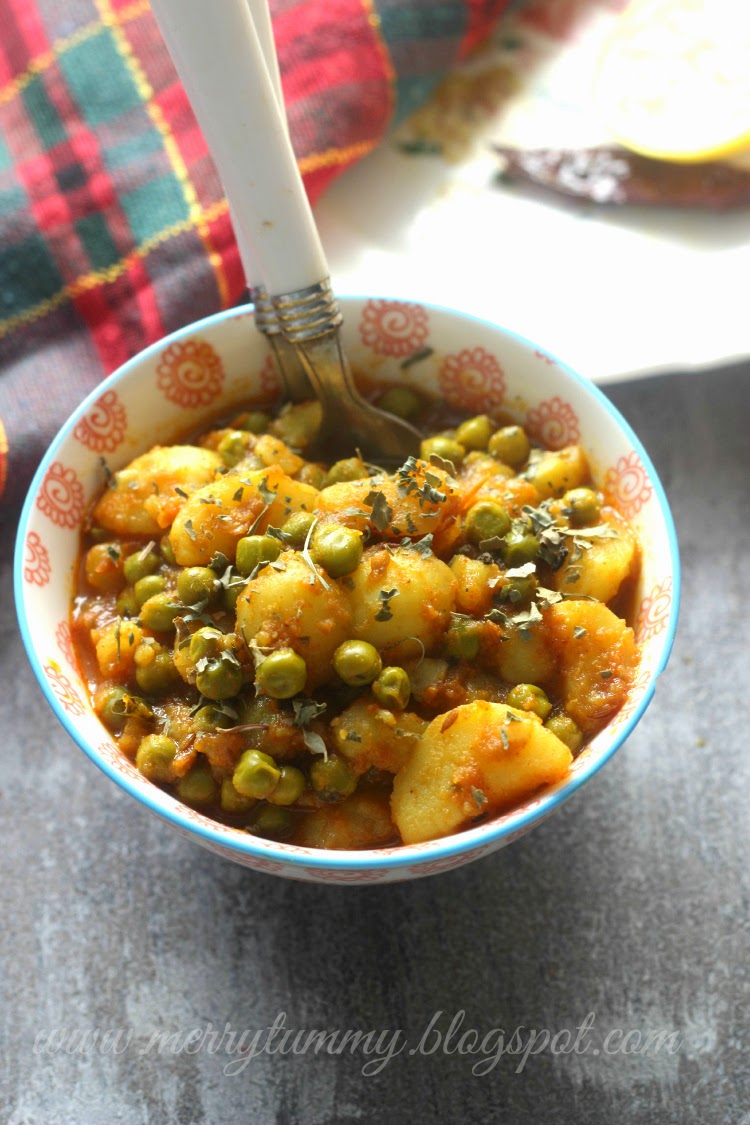
Aloo Matar Ki Subji, Restaurant Style


Nothing beats home cooked food...better if it’s made by your mother. Agree? 7.30 pm and I was back from my accounts tuition class. Maa was in the kitchen, in a printed blue chiffon sari, cooking dinner for us. Very carefully she added spices and gave it a mix. Quickly she kneads the dough and started making piping hot parathas. Oh that moment, when I close my eyes, I can see it all. Quick boil in the curry and she gave a spoon and asked to taste it. I grabbed the spoon and tasted aloo mutter ki subji, she waited for my answer...with spark in my eyes I replied-maa its super yummy, just like restaurant, how do you cook it?  Those little moments between a daughter and a mom, I wish I could freeze them forever.

Years later, she taught me how to make Aloo Mutter ki subji, like hers. Every now and then when I cook this subji, I wish I was a young girl who could go back to those days again. That’s about cooking, it engulfs you in memories and then when you bite into it, everything becomes better. Restaurant style aloo mutter ki subji (potatoes and peas curry) is one of those memorable dishes that happens once a while in my kitchen...it is a not every day curry, you need time and patience to cook this.


So what makes a perfect restaurant style Aloo Mattar Ki Subji?
  • Consistency-it is not dry (sukha) and it is not very watery (rassewali, jholwali) either; it is the balance of two, where you add water only to coat the veggies.
  • Dried fenugreek leaves (Kasturi methi)- you have and have to serve this curry with sprinkle of  kasturi methi.
  • Ginger and garlic paste- this is a must too. For the authentic taste, you need to add ginger garlic paste.
  • Tomato puree- for the restaurant style, tomato puree is what you need; there must be no chunks of tomatoes.
  • Garam Massala- Garam massala is a hot spice mix and it is one of the most important ingredients to make the perfect restaurant style curry.
So to master the perfect taste, please follow the above steps- not that complicated-isn’t it? So, lets see the recipe.


Ingredients:
4 medium size potatoes, boiled and chopped
1/2 cup green peas/mutter boiled
2 medium size tomatoes
1 teaspoon ginger-garlic paste
2 tablespoons oil
1/4 teaspoon asafoetida/hing
1 bay leaf/tej patta
1 teaspoon cumin seeds/jeera
1/2 teaspoon turmeric powder/haldi
1 and 1/2 teaspoon red chilli powder/lal mirch
1 teaspoon coriander powder/dhaniya
1/2 teaspoon garam massala (recipe here)
Salt to taste
1 cup water
1 teaspoon dried fenugreek leaves/kasuri methi (see notes)

Method:
In a blender, blend tomatoes with 4 tablespoons of water, garam massala, coriander powder, turmeric powder and red chilli powder into puree.
Heat oil in a wok/kadai. When hot, add cumin seeds. Let it crackle.
Add, bay leaf and asafoetida.
Add ginger garlic paste and cook for 1 minute. Turn the heat to slow.
Add tomato and spices puree. Mix. Cover and cook till tomatoes paste become red in colour and oil starts appear on the sides. Approximately for 8 minutes.
Add salt, chopped potatoes and peas. Mix. Add 1 cup water. Cover and cook again for 10 minutes. After 10 minutes, cook again for 5 minutes, the spices must have coated the potatoes and peas. If you see it is water, let it boil for more time.
Garnish with kasuri methi and serve.


Notes:
Cook it on slow heat, this ensures that spices are well blended with potatoes and peas.
You can add chopped coriander leaves as well.
This is a bit on spicy side, feel free to reduce the quantity of red chilli powder as per your taste.
Kasturi methi (dried fenugreek leaves) is easily available in any Indian grocery store. I used MDH one.  

Serving suggestions:
Serve with any Indian bread- roti, parathas, puri or naan.
It is simple in process, but the taste is really elegant, so why not serve in parties.
Goes well with rice as well.
For Punjabi thali, serve it with rice, makke ki rotidal makhani and some chilli pickle.
For gujarati thali, serve it with palak puri, keri nu ras and dhokla.
For rajasthani thali- serve it with jowar ki rotimarwadi Bharwa Bhindi. and parathas.

Thursday, April 9, 2015

Aloo Palak (Potatoes Spinach Side) Restaurant Style: Dry Version


You miss the food you love when you are away from it. It happened three years back when we were on our 17 days Europe trip.We ate pasta, panini and pizza every single day and we missed Indian food to the core. Mr. Husband and we decided to search for Indian food that too in Paris. Now, if you are vegetarian, I am pretty sure you will agree how tough it is to find vegetarian food, that too specifically Indian where no one understands your language. Roaming on the streets of Paris for almost 2 hours, we finally saw a Pakistani restaurant.

All the main dishes were non vegetarian and on the corner or the menu we found three vegetarian sides. Aloo gobi (potatoes cauliflower), which my husband hates; daal tadka (lentils), which we had to order and lastly aloo palak (potatoes and spinach). That was the first time ever in 27 years when I must have tasted how aloo palak in restaurant tastes like. For us, alu palak is more like everyday curry(subji) and while eating in restaurants we always order exotic dishes like paneer butter massala, Punjabi dum aloo or paneerkofta.

We sat in French-cum-Pakistani ambiance to have our food- daal, alu palak, naan and rice. Aloo palak restaurant style was distinct from the one we cook at our homes. We were so hooked with its taste that till date I whenever I cook aloo palak, it always restaurant style.


Aloo Palak (Potatoes Spinach Side) Restaurant Style is dry (sukha) made with chopped spinach and not pureed spinach. It is then loaded with spices and has incredible taste. You have to use chopped garlic so that when you eat you get tiny bits of garlic, which is really nice. With that goes in dry red chilli and basic Indian spices, cooked on real slow flame-the result is that every inch of potato is coated and infused with flavours. The ratio of potatoes and spinach is also the key to make successful restaurant style subzi (curry)- that is 2:1. Here I used 2 cups of chopped boiled potatoes and 1 cup of chopped spinach- you get the picture? Let’s see the recipe.

Ingredients:
2 cups boiled potatoes, chopped in cubes.
1 cup chopped spinach
4 cloves of garlic/lehsun, chopped
1 inch ginger/adrak, chopped
Pinch asafoetida
2 tablespoon cooking oil (I used vegetable oil)
2 dry red chillies
1 teaspoon cumin seeds/jeera
1 teaspoon turmeric powder/haldi
1/2 red chilli powder
2 tablespoon coriander powder/dhaniya
Salt to taste
1 tablespoon lemon juice

Method:
Heat oil in a pan. When hot, add asafoetida and cumin seeds, let it crackle.
To it add, dry red chillies, ginger and garlic. Cook till garlic is brown in colour.
Throw in chopped spinach and turn heat to medium. Cook till spinach is soft.
Turn heat to slow, add chopped potatoes , turmeric and salt. Mix and cover and let it cook for 8-10 minutes.
Then add in all the remaining spices and lemon juice. Cover and let it sit covered for 5 minutes.
Serve hot.

Notes:
You can use whole baby potatoes as well.
I used baby spinach, feel free to use bunched one as well.

Serving suggestions:
Serve with any indian bread- puri, parathas or naan.
Goes well as side with rice and daal tadka.
For the complete Punjabi thali serve it with makke ki roti paneer butter massala and dal makhani.
For rajasthani thali pair it with mangodi muttermarwadi lehsun ki chutney and jowar ki roti